Your agents can only access
what you allow.
Transparent proxy that intercepts every HTTP call, enforces policies, isolates credentials, and logs every decision.
 Get Started Free
Block risky actions · Full audit trail · Deploy in 5 minutes
What is TameFlare?
TameFlare is a control layer for AI agents: every outbound API call is evaluated against policy before it executes. Under the hood, a transparent HTTP/HTTPS proxy intercepts requests, parses them with 8 built-in connectors, and allows, denies, or holds them for human approval.
Agents never see real API keys - credentials are injected from an AES-256-GCM encrypted vault at request time. Zero code changes. Run any process with tf run -- python agent.py.
See it in action
Full visibility. Zero guesswork.
A single dashboard for traffic, policies, gateways, and approvals. This is the real UI.
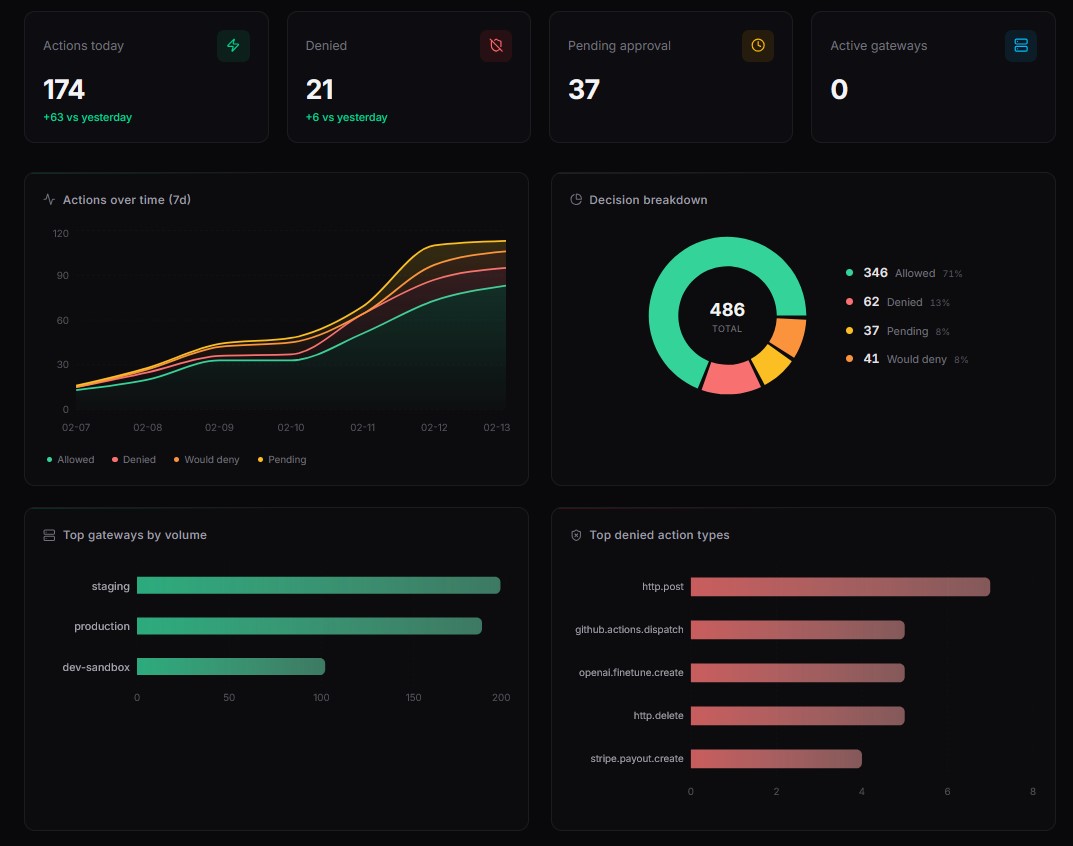
Dashboard overview
Real-time analytics, action breakdown, and gateway health at a glance.
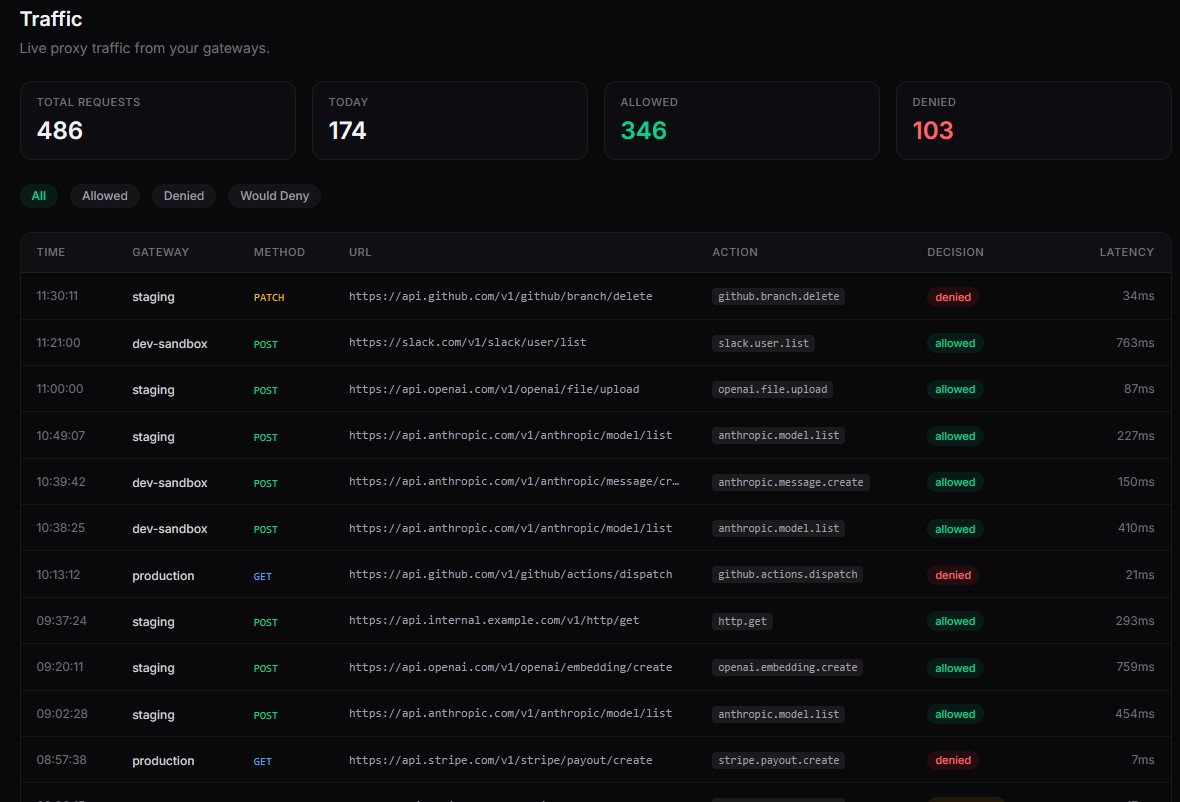
Live traffic log
Every proxied request with gateway, method, URL, action type, decision, and latency.
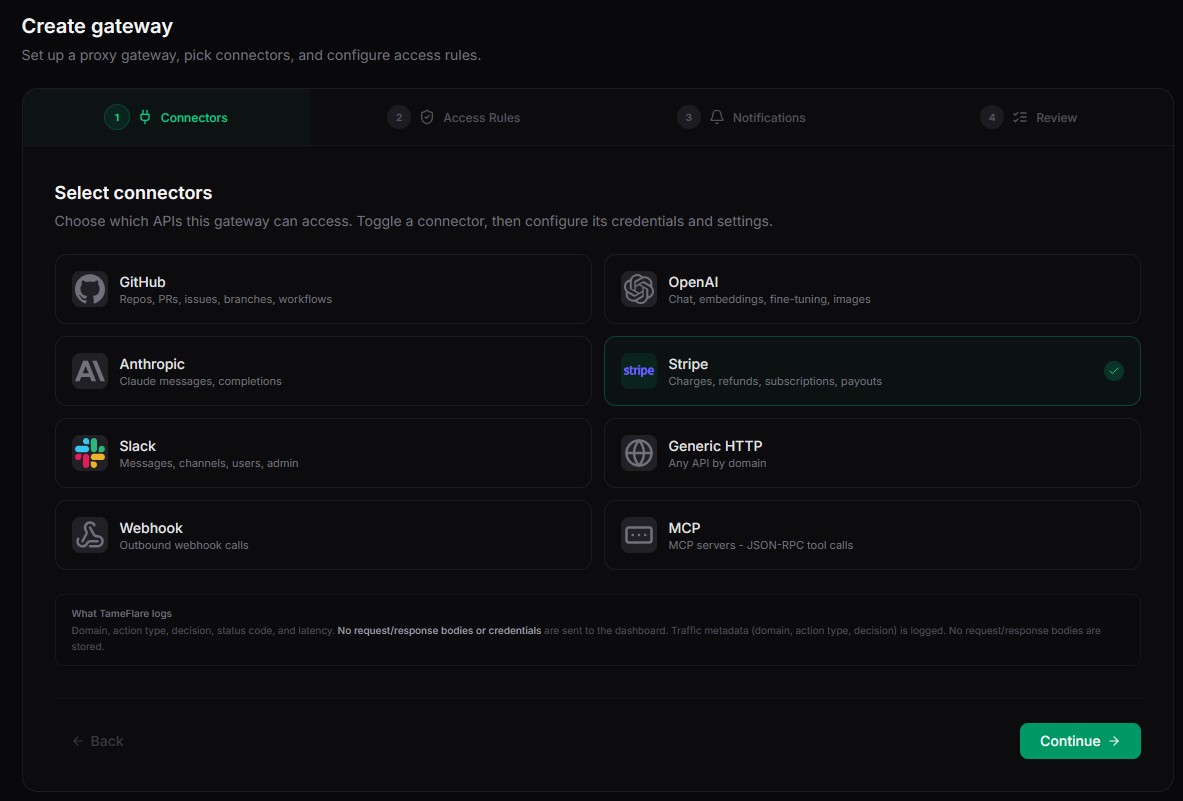
Gateway wizard
Pick connectors, set access rules, configure notifications, and deploy in minutes.
Three steps to governed traffic
Install the CLI, set up a gateway, wrap your agent. Zero code changes. Under five minutes.
Install the CLI
$ npm install -g @tameflare/cli$ tf login$ tf initInstalls the CLI, authenticates, and connects to the TameFlare control plane.
Set up a gateway
The wizard at tameflare.com/dashboard walks you through it.
Run your process
$ tf run -- python agent.py# All HTTP traffic is now proxied.# Agent never sees real API keys.# Every call is logged and governed.Works with Python, Node.js, Go, Rust, shell scripts - anything that makes HTTP calls.
The problem
AI agents are shipping to production. They merge code, send emails, transfer money - often without a human in the loop.
No guardrails
Most agents have no runtime guardrails beyond prompt instructions. A hallucination can cause irreversible damage.
No visibility
No record of what the agent did, why, or who approved it. Debugging and compliance become impossible.
No kill switch
If an agent goes rogue, there's no centralized way to halt all activity instantly.
Transparent proxy enforcement
Zero code changes required
Wrap any process with tf run. All outbound HTTP traffic is routed through the gateway. Connectors parse requests into structured actions. Credentials are injected from the encrypted vault.
No SDK required. The process doesn't know it's being governed.
Everything you need to govern
agent behavior
From connector setup to emergency shutdown.
Connector system
GitHub connector parses 20+ action types from raw HTTP. Generic connector works with any API. Add connectors via CLI or dashboard.
Per-gateway permissions
Deny-all by default. Explicitly allow each process to use specific connectors and actions. Wildcard patterns supported.
Human-in-the-loop
Set actions to require_approval. The proxy holds the connection until a human approves via CLI or dashboard.
Credential vault
API keys stored in an AES-256-GCM encrypted vault. Injected by the proxy at request time. Agents never see real credentials.
Scoped kill switch
Block all traffic, a specific connector, or a single process. Instant effect, no requests forwarded.
Live traffic log
Every proxied request logged with agent, action, decision, latency. Filterable dashboard with auto-refresh.
Connectors parse every API call into a structured action
8 built-in connectors covering GitHub, OpenAI, Anthropic, Stripe, Slack, generic HTTP, webhook, and MCP. Permissions match on gateway, connector, and action pattern.
Source control
Block branch deletion, require merge approval
Payments
Limit transfer amounts, block sanctioned currencies
Infrastructure
Block prod DB drops, limit cluster scaling
Communications
Review external emails, block mass sends
Data access
Approve PII queries, block bulk deletes
Agent orchestration
Control sub-agent spawning and delegation
Built for anyone running AI agents
Whether you're a solo developer or a team shipping to production - TameFlare gives you control from day one.
Solo developers
Ship agents with confidence. Set up a gateway in minutes, define what your agent can access, and get a full audit log. Free Starter tier, no credit card.
Small teams
Share gateways across projects, scope permissions per agent, and review activity from a single dashboard. Policy changes take effect instantly.
Security-conscious builders
Fail-closed enforcement at the network layer. Agents never see real API keys. Every decision is logged.
Works with the tools your agents already use
What teams are saying
“We deployed TameFlare in front of our LangChain agents and blocked three unauthorized production writes in the first week. The policy engine is exactly what we needed.”
Sarah C.
Head of Platform, Series B Fintech
“The transparent proxy approach means our agents don't even know they're being governed. Zero code changes, full visibility. We went from no oversight to complete audit trails in under 24 hours.”
Marcus W.
CTO, AI Automation Agency
“Our compliance team finally stopped blocking our AI initiatives. TameFlare gives them the kill switch and approval workflows they need, and gives us the freedom to ship in one governed workflow.”
Priya S.
VP Engineering, Enterprise SaaS
Set up your first gateway
in under 5 minutes.
Free Starter plan. No credit card. Set up a gateway and govern your first agent in minutes.